The Pentagram
The Reincarnated Demon King's Host Just Wants to Live in Peace, But the Hero Won't Leave Him AloneThe Pentagram is the group formed by Malthios, Kamil, Aym, Torq, and Foras during their Novice training. Although its members begin as a small and apparently insignificant unit within the Demon hierarchy, their shared victories, affection, and eventual deaths give the organization a lasting importance far beyond its military size. The Pentagram becomes the standard against which Malthios measures every later identity: before he was a king, he was its leader; before his power became an instrument of slaughter, it belonged to a circle of friends who trusted one another.
Formation and Early Structure
The Pentagram was assembled among the Novices, a rank made up of Demonkin granted mana by a Demon Lord sponsor. Demonkin ordinarily possessed little or no mana and could serve as common soldiers, whereas Novices combined considerable physical ability with varying magical potential. Above them stood the Demon Lords, whose ascension followed massive slaughter of innocents and brought immense mana together with wings. The group therefore began inside a rigid system in which advancement was inseparable from violence.
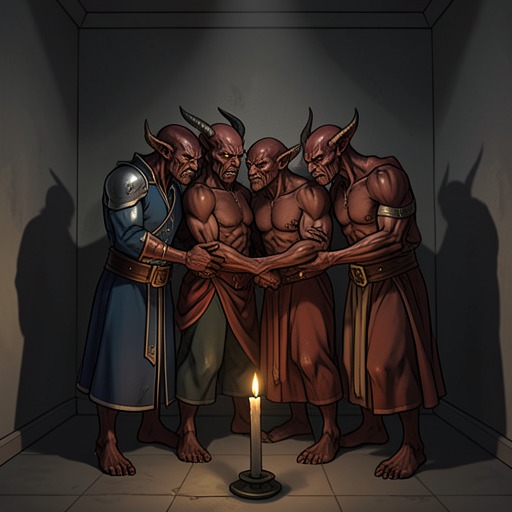
The five members were initially placed in a training contest in which the Novices were divided into groups and ordered to protect their own flag or steal another group’s. The Pentagram was by far the smallest group, making its success an early demonstration that cohesion could compensate for numbers. Kamil introduced Malthios to the others with evident pride, asking Aym whether he was a good fit. Her celebration when the group was complete was direct and exuberant: she declared, “Pentagram assembled!” The name thus marked more than a tactical unit. It was a claim that five separate figures had become a single formation.
Kamil, Aym, Torq, and Foras became the emotional companions whose memories later govern Malthios’s choices. The group’s internal character is suggested through the recollections that survive its destruction: Kamil’s laughter, Aym’s soft smile when they first woke, Torq’s warmth when he embraced them all, and Foras’s dry humor. These details distinguish the Pentagram from the anonymous military structures around it. Its members are remembered not as interchangeable Novices but through particular gestures, voices, and forms of tenderness.
Military Role and Moral Contradiction
The Pentagram’s early missions reveal the contradiction at the heart of its existence. One assignment sent the group to a large mortal city with instructions to kill every living thing they encountered. The mission was completed quickly, showing both the group’s effectiveness and the brutal purpose of the institution that trained it. Their collective strength could produce remarkable results, but those results were measured by the destruction of civilian life.
That contradiction deepens as the members rise in power. Malthios later remembers the Pentagram as the source of his identity and belonging, yet his advancement depends on the same culture of slaughter that will eventually consume them. The group’s emotional intimacy exists inside a hierarchy that rewards mass killing, and the warmth of their private bond cannot protect them from the political logic of Demon society. Their story therefore turns the conventional image of an elite warband inside out: the group is admirable in loyalty and courage, but the system gives those virtues a destructive outlet.
During a later crisis, Malthios orders the other four to take a battalion out while he remains behind to hold off their attackers. The decision shows the group’s military trust and Malthios’s willingness to place himself between his friends and danger. It also foreshadows the separation that will become permanent. The Pentagram can survive tactical disadvantage, but it cannot survive the larger conflict between rival Demon Lords, the Hero, and the ambitions attached to ascension.
Destruction and Malthios’s Ascension
The Pentagram is destroyed when its members are killed in the violence surrounding Malthios’s struggle with Naamah. Naamah dismisses the group as unworthy of the power it claimed, arguing that, if the Pentagram had truly been strong, it would have defeated the Hero. She singles out Aym with contempt, reducing one of Malthios’s closest friends to an example of supposed weakness.
Malthios’s response makes the Pentagram the foundation of his subsequent identity. He tells Naamah that she has no right to speak Aym’s name, or any of the others’ names, because he is alive through them and has become who he is because of them. He then attacks her despite facing a dozen opponents to one. The combat is driven not merely by political rivalry but by the visual return of the friends he has lost: Aym’s startled stillness, Torq throwing himself in front of Foras, and Kamil smiling at him appear before Malthios as he fights.
After Naamah is reduced to scattered ashes, Malthios’s mana surges in the same manner as it did when he first ascended to Demon Lord. Blood on his skin and clothes seems to sink into him, and his wings extend to their full length. Their glossy black feathers turn dark blood red before the watching demons, many of whom have anticipated the transformation since Malthios began killing his own kind. The Pentagram’s destruction is therefore not only a loss. It is the threshold through which Malthios becomes Demon King, with grief and vengeance converted into the visible sign of a higher rank.
Memory, Loyalty, and Aftermath
For immortals who believe they have endless years, decades pass quickly, and Malthios later regrets failing to make the fifty years after his ascension fully meaningful. His memories of the Pentagram remain the brightest part of that period, but they also become painful because darker memories replace the happiness they once contained. The organization survives in recollection as a wound: every remembered laugh, smile, embrace, or joke carries the knowledge that the people who made those moments possible are gone.
When Malthios confronts the prospect of further power, he continues to define himself through the Pentagram. He insists that he was still Malthios, strongest of all demons and leader of the Pentagram, before he was crowned King. Even after gaining a host and becoming stronger than he had been in his original life, he presents leadership of the group as more fundamental than kingship. The statement reverses the hierarchy’s usual values. Royal authority is an acquired title; belonging to the Pentagram is the identity he regards as genuine.
The names Kamil, Aym, Foras, and Torq are later recalled together, as if listing them can briefly restore the group’s completeness. Their memory also shapes Malthios’s decision to coexist peacefully with Theo. Malthios recognizes that Theo expects nothing from him and allows him to be someone he has not been since his crowning and the loss of his friends. The contrast is decisive: the Pentagram represents the loving community Malthios lost, while Theo offers a new form of acceptance that does not require slaughter or domination.
Narrative Significance
The Pentagram gives the larger conflict its personal scale. The struggle between Demon Lords, the Hero, and the Demon King could otherwise be understood as a contest for rank, territory, or military supremacy. Through the Pentagram, however, Malthios’s rise is inseparable from the destruction of his chosen family. His transformation into Demon King is both an achievement within Demon society and the consequence of a catastrophe that leaves him spiritually divided.
The group also establishes the book’s central contrast between inherited categories and chosen bonds. Its members are formed by a violent hierarchy, yet what Malthios treasures is not their status as Novices or future Demon Lords but their laughter, warmth, humor, and mutual protection. The Pentagram’s legacy persists because it gives Malthios a moral memory capable of resisting the values that created him. In the end, the organization is gone as a living force, but its fellowship remains the hidden measure of Malthios’s later change: power may make him a king, while loyalty to the dead teaches him what kind of person he no longer wishes to be.